New Tax Regime 2026: How Much Tax Can You Really Save? The Answer May Surprise You!
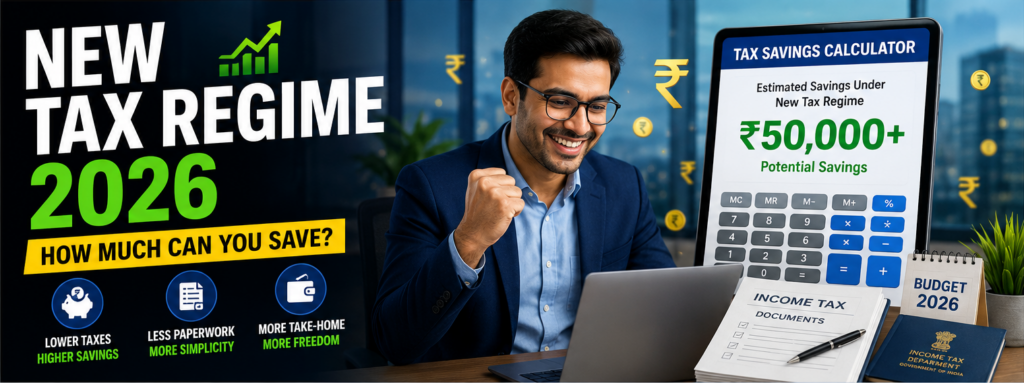
Every year, millions of Indians struggle to understand income tax. Should you choose the old tax regime or the new one? Which option saves more money?
The New Tax Regime introduced by the Government of India aims to make taxation simpler and reduce paperwork. But many taxpayers still wonder:
“Will I actually save money?”
The answer depends on your salary, deductions, and investments.
Let’s break it down in the simplest way possible.
What Is the New Tax Regime?
The New Tax Regime offers:
✅ Lower tax rates
✅ Fewer complications
✅ No need for most deductions and exemptions
✅ Faster tax filing
The government has gradually made the new regime more attractive, and it is now the default tax regime for many taxpayers.
Biggest Benefit: Tax-Free Income Up to ₹12 Lakh*
For many salaried individuals, effective tax liability can become zero up to certain income levels after considering available rebates and standard deductions.
This means a large number of middle-class taxpayers may not pay any income tax at all.
Example 1: Salary ₹8 Lakh
Old Regime
- Tax-saving investments required
- Multiple deductions needed
- Paperwork and proofs required
New Regime
- Minimal paperwork
- Lower tax rates
- Potentially lower tax burden
Estimated Saving: ₹10,000–₹25,000 depending on deductions claimed.
Example 2: Salary ₹12 Lakh
Many salaried employees earning around ₹12 lakh annually can significantly reduce their tax burden under the new regime.
Benefits include:
- Standard deduction
- Rebate benefits
- Simplified filing process
Possible Savings: ₹20,000–₹60,000 compared to taxpayers who don’t fully utilize deductions under the old regime.
Example 3: Salary ₹18 Lakh
For higher-income earners, the comparison becomes more interesting.
If you already invest heavily through:
- Section 80C
- Home loan benefits
- NPS
- Health insurance deductions
The old regime may still compete.
However, many professionals who don’t claim large deductions may save substantially under the new regime.
Why Young Professionals Love the New Regime

The new generation often prefers:
- Flexibility
- Higher take-home salary
- Less paperwork
- Freedom from forced investments
Instead of locking money into tax-saving products, they can invest according to their financial goals.
Hidden Advantage Most People Ignore
Under the old regime, many people invested only to save tax.
This often resulted in:
❌ Poor investment choices
❌ Low returns
❌ Money locked for years
The new regime encourages smarter financial planning based on actual needs rather than tax-saving pressure.
Who Should Choose the New Tax Regime?
You may benefit if:
✔ You are a salaried employee
✔ You don’t have a home loan
✔ You don’t claim many deductions
✔ You prefer simplicity
✔ You want higher monthly take-home income
Who Should Consider the Old Tax Regime?
You may prefer the old regime if:
✔ Large home loan interest deductions
✔ Significant 80C investments
✔ NPS contributions
✔ Health insurance deductions
✔ Multiple tax-saving exemptions
Quick Comparison
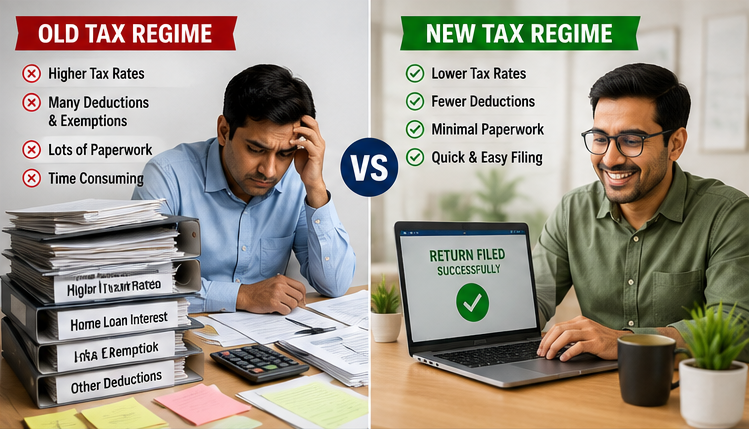
| Feature | Old Regime | New Regime |
|---|---|---|
| Tax Rates | Higher | Lower |
| Deductions | Many | Limited |
| Paperwork | More | Less |
| Simplicity | Moderate | High |
| Flexibility | Lower | Higher |
Tax Planning Tip for 2026
Before filing your return:
- Calculate tax under both regimes.
- Compare total tax payable.
- Choose the option with lower liability.
- Review annually.
A choice that saved money last year may not be the best option this year.
Conclusion
The New Tax Regime is changing how Indians think about taxes. For many salaried employees, it offers lower taxes, fewer complications, and greater flexibility.
The biggest takeaway is simple:
Don’t assume. Calculate.
A quick comparison could save you thousands—or even lakhs—of rupees every year.
The smartest taxpayers aren’t the ones who pay the least tax. They’re the ones who understand their options.
FAQ Section
1. Is the new tax regime better than the old regime?
Answer: It depends on your income and deductions. Taxpayers with fewer deductions often benefit from the new regime.
2. Can I switch between old and new tax regimes?
Answer: Most salaried individuals can choose the regime while filing their tax return, subject to applicable rules.
3. Does the new regime allow deductions?
Answer: Only a limited number of deductions and exemptions are available compared to the old regime.
4. Who benefits the most from the new tax regime?
Answer: Employees and professionals who do not claim significant deductions generally benefit the most.
5. Should I calculate tax under both regimes?
Answer: Yes. Comparing both options before filing can help you choose the lower tax liability.