10 Everyday Psychology Tricks Your Brain Uses Without You Realizing
Have you ever bought something just because everyone else was buying it? Or remembered an embarrassing moment from years ago but forgotten what you had for lunch last week?
The answer lies in the way your brain works. Every day, your mind uses mental shortcuts to make quick decisions. These shortcuts are incredibly useful, but they can also influence your choices without you even noticing.
Let’s explore 10 fascinating psychology tricks your brain uses every single day.
1. The Halo Effect
Have you ever assumed someone is smart just because they’re well-dressed or friendly?
That’s the Halo Effect.
When we notice one positive quality about a person, our brain often assumes they have other positive qualities too.
Example:
A friendly waiter may seem more trustworthy simply because they smile.
2. Confirmation Bias
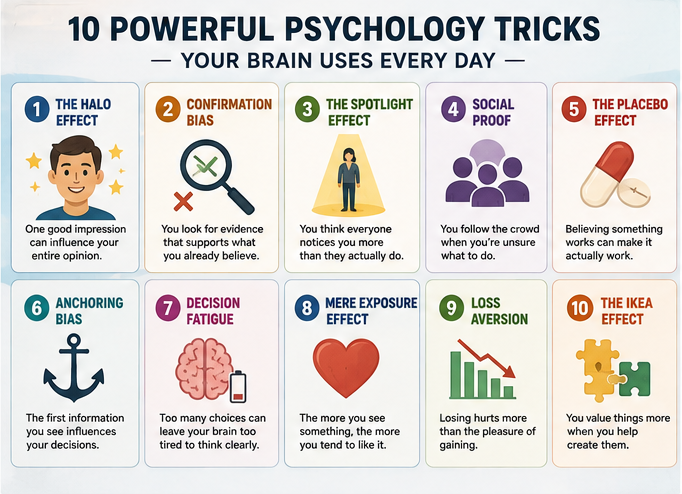
People naturally look for information that supports what they already believe.
At the same time, they often ignore information that challenges their opinions.
Example:
If you think a certain phone brand is the best, you’ll probably notice positive reviews more than negative ones.
3. The Spotlight Effect
We often think everyone is paying attention to us.
In reality, most people are focused on themselves.
Example:
If you accidentally trip in public, you may think everyone noticed—but most people forget it within minutes.
4. Social Proof
When we’re unsure what to do, we copy what other people are doing.
This helps explain why crowded restaurants often attract even more customers.
Example:
A product with thousands of positive reviews feels more trustworthy.
5. The Placebo Effect
Sometimes, simply believing something will help can make you feel better—even if it has no active ingredients.
Your expectations can influence how your body responds.
6. Anchoring Bias
The first number or piece of information you see can influence future decisions.
Example:
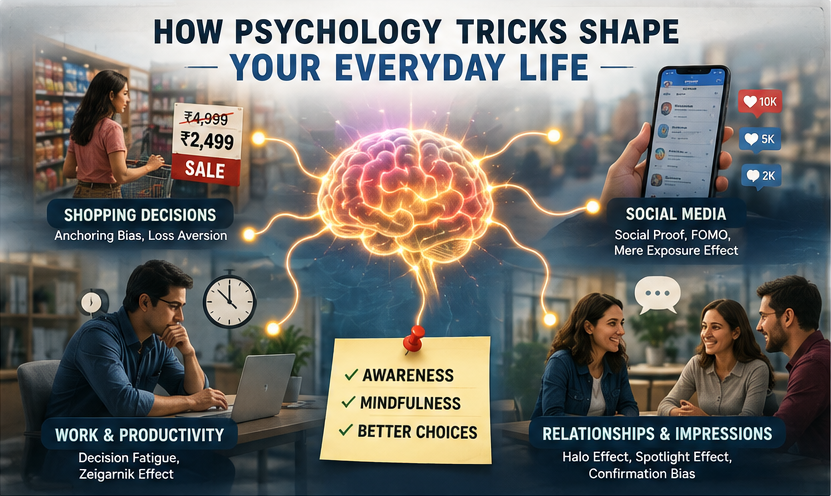
A shirt marked “₹4,999” and then discounted to “₹2,499” feels like a great deal, even if ₹2,499 is its usual price.
7. Decision Fatigue
Making lots of decisions throughout the day can leave your brain feeling mentally tired.
As a result, later decisions may become impulsive or less thoughtful.
8. The Mere Exposure Effect
The more often you see something, the more likely you are to like it.
This is why advertisements repeat the same message again and again.
9. Loss Aversion
People generally dislike losing something more than they enjoy gaining something of equal value.
Example:
Losing ₹500 usually feels worse than the happiness of finding ₹500.
10. The IKEA Effect
We value things more when we’ve helped create them.
That’s why assembling your own furniture—or completing a DIY project—can make it feel more valuable.
Why Does Our Brain Use These Tricks?
Your brain processes enormous amounts of information every day.
To save time and energy, it relies on mental shortcuts called cognitive biases. Most of the time they help us make quick decisions, but they can also lead to mistakes.
Understanding these patterns helps us make better decisions in daily life.
Tips to Avoid Mental Biases
- Think before making important decisions.
- Read opinions from different viewpoints.
- Don’t judge people based only on first impressions.
- Take breaks when making many decisions.
- Check facts before sharing information online.
Frequently Asked Questions
1. Are psychology tricks real?
Answer: Yes. Most of these mental shortcuts are supported by decades of research in cognitive psychology and behavioral science.
2. Why does the brain use shortcuts?
Answer: Mental shortcuts help us process information quickly without having to analyze every situation from scratch.
3. Can understanding psychology improve decision-making?
Answer: Yes. Recognizing common biases can help you make more balanced choices in shopping, relationships, work, and everyday life.
4. Do advertisements use psychology?
Answer: Many advertisements use psychological principles such as social proof, repetition, scarcity, and anchoring to capture attention and influence buying decisions.
5. Are cognitive biases always bad?
Answer: No. They often help us make quick decisions, but they can sometimes lead to inaccurate judgments if we’re not aware of them.
6. Can I train my brain to reduce bias?
Answer: You can’t eliminate biases completely, but you can reduce their impact by slowing down, questioning assumptions, and considering alternative viewpoints.
Conclusion
Your brain is constantly working behind the scenes, helping you make decisions, remember information, and navigate everyday life. While these mental shortcuts are incredibly useful, being aware of them can help you think more clearly and make smarter choices.
The next time you catch yourself making a quick judgment or following the crowd, remember—it might just be one of your brain’s hidden psychology tricks at work.
Interesting Blogs
- 15 Amazing Human Body Facts That Sound Fake (But Are True)
- 10 Ancient Civilizations That Were Far More Advanced Than You Think
- The Internet in 2035: 10 Technologies That Will Change Everything
External References
- American Psychological Association (APA): https://www.apa.org/
- National Institute of Mental Health (NIMH): https://www.nimh.nih.gov/
- Simply Psychology: https://www.simplypsychology.org/
- Verywell Mind: https://www.verywellmind.com/