New Tax Regime 2026: 10 Tax-Saving Benefits Most Indians Still Don’t Know About
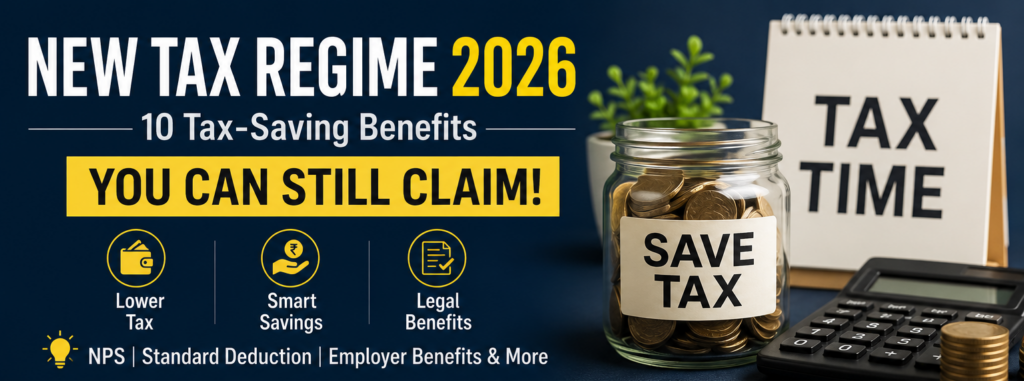
Many taxpayers believe that once they switch to the New Tax Regime, all tax-saving opportunities disappear.
That’s simply not true.
While popular deductions like 80C, PPF, ELSS, Life Insurance Premiums, and Health Insurance deductions are mostly unavailable, several powerful tax-saving benefits still remain. In fact, some of them can save salaried employees tens of thousands of rupees every year.
Let’s look at the complete list.
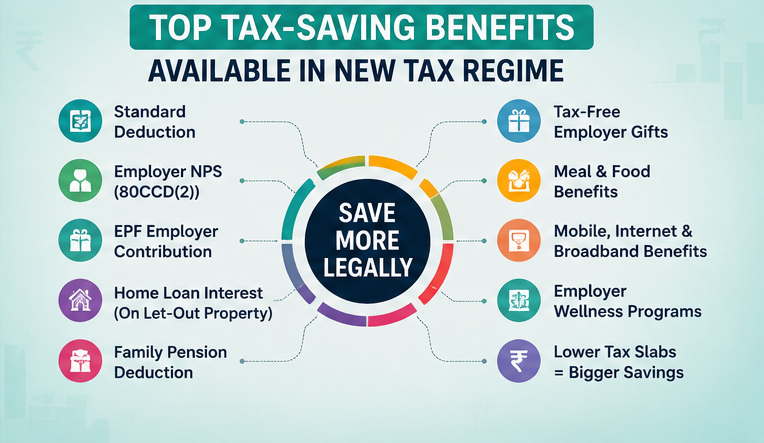
1. Standard Deduction – ₹75,000
The easiest tax benefit under the New Tax Regime is the Standard Deduction.
Every salaried employee and pensioner can claim a deduction of ₹75,000 from taxable income without submitting any investment proof.
Example
If your salary is ₹12,75,000:
- Gross Salary = ₹12,75,000
- Standard Deduction = ₹75,000
- Taxable Income = ₹12,00,000
This deduction is automatic and requires no paperwork.
2. Employer Contribution to NPS [Section 80CCD(2)]
This is arguably the most powerful tax-saving benefit still available under the New Tax Regime.
Employer contributions to your NPS account can be deducted from taxable income. Private-sector employees can claim up to 14% of Basic Salary under the new regime.
Why This Matters
Suppose:
- Basic Salary = ₹10,00,000
- Employer contributes 14% = ₹1,40,000
You can reduce taxable income by ₹1,40,000.
Many salaried employees are unaware of this benefit and miss significant savings.
3. Tax-Free Employer EPF Contribution
Employer contributions to EPF continue to receive favorable tax treatment under applicable limits. This can help employees build retirement wealth while reducing taxable exposure.
4. Home Loan Interest on Let-Out Property
If you own a rented property, interest paid on the home loan can still be claimed under specific provisions. This is one of the few housing-related tax benefits that survives under the New Tax Regime.
5. Family Pension Deduction
Family pension recipients can claim a deduction under the new regime subject to prescribed limits. Many retirees and family pension beneficiaries overlook this benefit.
6. Tax-Free Employer Gift Benefits
Gifts received from employers up to specified limits remain exempt from tax. Festival gifts, reward vouchers, and recognition awards may qualify depending on their value and structure.
7. Meal Coupons & Food Benefits
Certain employer-provided meal benefits continue to enjoy tax advantages under the new regime. Companies offering meal cards or food benefits can help employees reduce taxable expenses.
8. Mobile, Internet & Broadband Reimbursements
Many employers reimburse:
- Mobile bills
- Internet charges
- Broadband expenses
These can remain tax-efficient when structured according to company policies.
9. Employer Wellness Programs
Health and wellness benefits provided by employers may qualify for tax exemptions in certain cases.
Examples include:
- Health checkups
- Employee wellness programs
- Financial wellness initiatives
These benefits can increase your effective compensation without increasing tax liability.
10. Lower Tax Slabs Themselves Are a Hidden Saving
Many people focus only on deductions and forget that the New Tax Regime’s biggest benefit is lower tax rates.
For taxpayers with limited investments and deductions, the new slabs can often result in lower overall tax liability even without claiming traditional exemptions.
Benefits You CANNOT Claim Under the New Tax Regime
Many taxpayers still get confused about this.
The following popular deductions are generally NOT available:
❌ PPF
❌ ELSS Mutual Funds
❌ Life Insurance Premium
❌ Section 80C Investments
❌ Section 80D Health Insurance
❌ Additional NPS Deduction under 80CCD(1B)
❌ HRA Exemption
❌ LTA Exemption
❌ Home Loan Interest for Self-Occupied Property
These remain available mainly under the Old Tax Regime.
Quick Comparison: Old vs New Regime
| Feature | Old Regime | New Regime |
|---|---|---|
| 80C Deduction | ✅ | ❌ |
| Health Insurance (80D) | ✅ | ❌ |
| HRA | ✅ | ❌ |
| Standard Deduction | ✅ | ✅ |
| Employer NPS (80CCD2) | ✅ | ✅ |
| Lower Tax Rates | ❌ | ✅ |
| Simpler Filing | ❌ | ✅ |
Who Should Choose the New Tax Regime?
The New Tax Regime is usually beneficial if:
- You don’t invest heavily in tax-saving products.
- Your employer offers NPS contributions.
- You prefer simpler tax filing.
- You have limited deductions under 80C and 80D.
Final Thoughts
The biggest misconception about the New Tax Regime is that there are “zero deductions.”
In reality, several valuable tax-saving opportunities still exist. The most powerful among them is Employer NPS Contribution under Section 80CCD(2), which can significantly reduce taxable income while building retirement wealth.
Before filing your return, review all available benefits carefully—you could save much more tax than you think.
FAQs
1. Is NPS deduction available in the New Tax Regime?
Answer: Yes. Employer contribution to NPS under Section 80CCD(2) remains available.
2. Can I claim 80C in the New Tax Regime?
Answer: No. Section 80C deductions are generally not available under the New Tax Regime.
3. What is the Standard Deduction in 2026?
Answer: Eligible salaried taxpayers can claim a standard deduction of ₹75,000.
4. Is Health Insurance deduction available?
Answer: No. Section 80D benefits are generally available only under the Old Tax Regime.
5. Which is the best tax-saving option under the New Regime?
Answer: Employer NPS contribution under Section 80CCD(2) is widely considered one of the most valuable tax-saving benefits available.