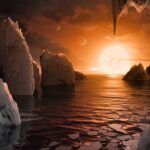
TRAPPIST-1 : The Tiny Star With Seven Earth-Like Worlds
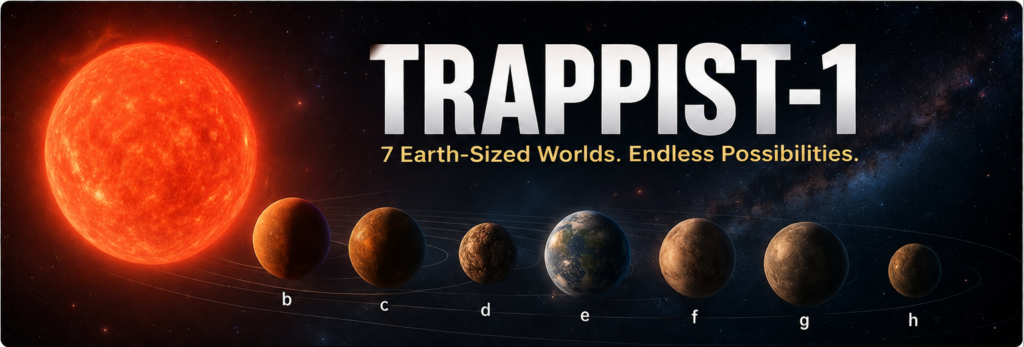
Imagine looking up at the night sky and knowing there’s a nearby star with seven Earth-sized planets, all packed closer together than Mercury is to our Sun.
Sounds like science fiction?
It’s completely real.
The TRAPPIST-1 star system has become one of the most exciting discoveries in modern astronomy because several of its planets orbit in the “Goldilocks Zone”—where conditions might allow liquid water to exist.
Scientists believe this tiny star could help answer one of humanity’s biggest questions:
Are we alone in the universe?
What Is TRAPPIST-1?
TRAPPIST-1 is an ultra-cool red dwarf star located about 40 light-years away from Earth in the constellation Aquarius.
Although it’s much smaller than our Sun, it’s incredibly important because it hosts seven rocky planets.
Key facts:
- Distance from Earth: 40 light-years
- Star Type: Ultra-cool Red Dwarf
- Age: Around 7–8 billion years
- Size: About 12% the size of our Sun
- Temperature: Nearly half as hot as our Sun
Despite being tiny, TRAPPIST-1 has become one of the most studied stars in the Milky Way.
Meet the Seven Planets
Scientists named the planets simply:
- TRAPPIST-1 b
- TRAPPIST-1 c
- TRAPPIST-1 d
- TRAPPIST-1 e
- TRAPPIST-1 f
- TRAPPIST-1 g
- TRAPPIST-1 h
All seven are roughly the size of Earth.
Three of them—e, f, and g—are considered especially interesting because they orbit inside or near the habitable zone.
Why Is Everyone Talking About the Habitable Zone?
The habitable zone is often called the Goldilocks Zone.
It isn’t too hot.
It isn’t too cold.
It’s “just right” for liquid water.
Since all life on Earth depends on water, planets in this zone become prime targets in the search for life.
TRAPPIST-1 has multiple planets in this region, making it unique.
How Close Are These Planets?
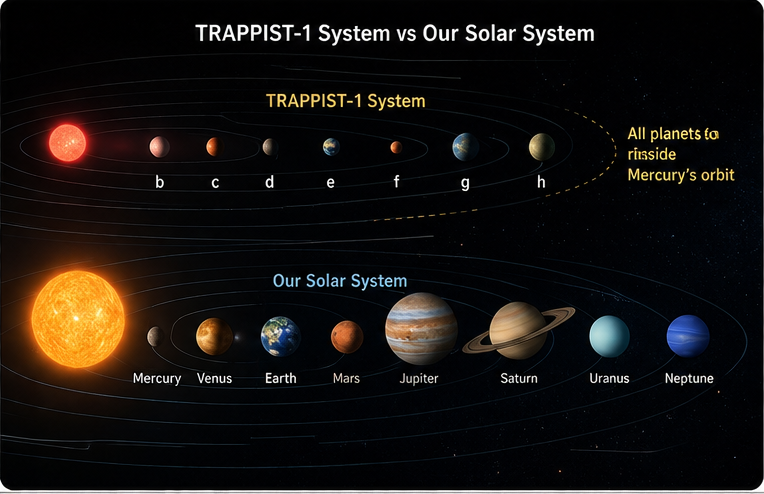
One amazing fact is how tightly packed the planets are.
If TRAPPIST-1 replaced our Sun:
- Every planet would orbit inside Mercury’s orbit.
- A year on some planets lasts only 1.5 Earth days.
- The outermost planet completes an orbit in less than three weeks.
This compact arrangement creates fascinating gravitational interactions between the planets.
Could There Really Be Life There?
This is the question everyone wants answered.
Scientists don’t know yet.
However, several conditions make TRAPPIST-1 exciting:
✔ Earth-sized rocky planets
✔ Multiple planets in the habitable zone
✔ Possible water
✔ Atmospheres may exist
However, there are challenges too.
The star occasionally produces powerful flares that may strip away planetary atmospheres over time.
That means some planets could be less friendly than they appear.
What Has the James Webb Space Telescope Found?
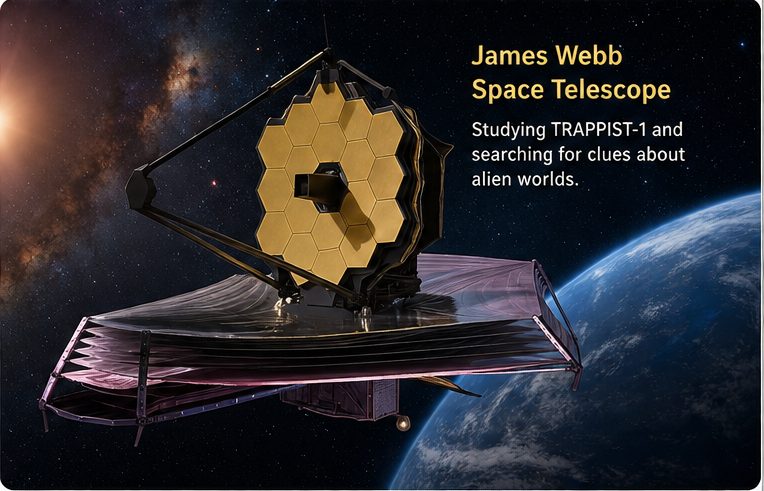
The James Webb Space Telescope (JWST) is now studying TRAPPIST-1 in unprecedented detail.
Recent observations have helped scientists:
- Measure planetary temperatures
- Search for atmospheres
- Study carbon dioxide and other gases
- Understand planetary formation
While no evidence of life has been found yet, JWST is providing the clearest view ever of these distant worlds.
Fun Facts About TRAPPIST-1
- The discovery was announced in 2017.
- The system was discovered using the transit method.
- The planets are so close together that neighboring worlds could appear larger in each other’s skies than our Moon appears from Earth.
- The star is much cooler than our Sun.
- It may remain active for trillions of years.
Why This Discovery Matters
Finding seven Earth-sized planets around one star changed astronomy forever.
Instead of wondering whether Earth-like worlds are rare, scientists now know they can exist in groups.
TRAPPIST-1 also provides the perfect laboratory for studying planetary atmospheres and the possibility of life beyond our Solar System.
Every new observation brings us one step closer to answering one of humanity’s oldest questions.
Frequently Asked Questions
1. Is TRAPPIST-1 closer than Proxima Centauri?
Answer: No. Proxima Centauri is the closest known star to Earth. TRAPPIST-1 is about 40 light-years away.
2. Can humans travel to TRAPPIST-1?
Answer: Not with today’s technology. Even our fastest spacecraft would take tens of thousands of years.
3. Which planet is most likely to support life?
Answer: Scientists consider TRAPPIST-1e one of the strongest candidates, but more observations are needed.
4. Has NASA found aliens there?
Answer: No. There is currently no evidence of life on any TRAPPIST-1 planet.
Final Thoughts
TRAPPIST-1 reminds us how much of the universe is still waiting to be explored.
Seven Earth-sized worlds orbiting a tiny nearby star have given scientists one of the best opportunities ever to search for signs of life beyond our Solar System.
Whether these planets are barren rocks or thriving worlds remains unknown—but the journey to find out has only just begun.