
10 Ancient Civilizations That Were Far More Advanced Than You Think
When we think about ancient civilizations, it’s easy to imagine simple villages and basic tools. But history tells a very different story.
Thousands of years ago, people built massive cities, tracked the stars, created complex calendars, and engineered structures that continue to puzzle experts today.
Let’s explore ten ancient civilizations that were far more advanced than most people realize.
1. Ancient Egypt
The Egyptians built the Great Pyramids with remarkable precision.
They also developed advanced mathematics, medicine, irrigation systems, and one of the earliest writing systems called hieroglyphics.
Famous For:
- Pyramids
- Mummification
- Astronomy
- Engineering
2. Mesopotamia
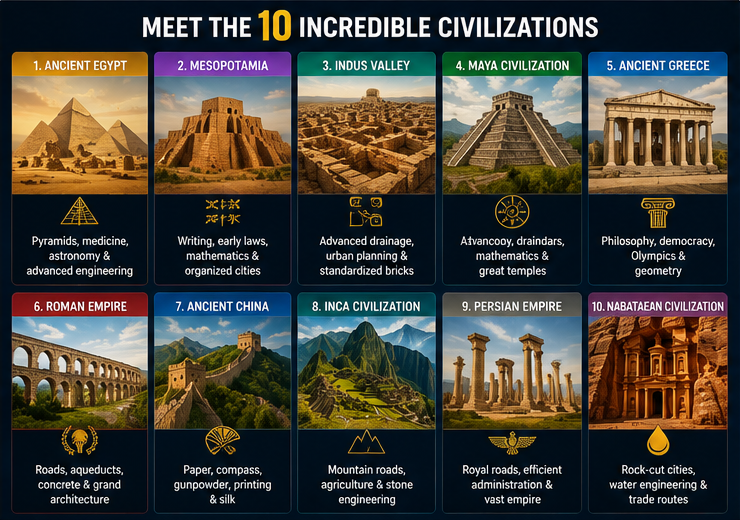
Often called the “Cradle of Civilization,” Mesopotamia introduced writing, organized cities, and legal systems.
The Code of Hammurabi became one of history’s earliest written law codes.
Famous For:
- Cuneiform writing
- Wheel
- Mathematics
- Early cities
3. Indus Valley Civilization
Cities like Mohenjo-daro and Harappa featured planned streets, drainage systems, and standardized bricks long before many later civilizations.
Famous For:
- Urban planning
- Sanitation
- Trade
- Architecture
4. Maya Civilization
The Maya created detailed calendars and made accurate astronomical observations.
They also developed an advanced writing system and impressive stone cities.
Famous For:
- Astronomy
- Mathematics
- Calendars
- Temples
5. Ancient Greece
Greek thinkers transformed philosophy, science, medicine, and democracy.
Many modern ideas in mathematics and engineering trace their roots back to ancient Greece.
Famous For:
- Democracy
- Philosophy
- Olympics
- Geometry
6. Roman Empire
The Romans built roads, bridges, aqueducts, and public buildings that lasted for centuries.
Their engineering techniques influenced construction around the world.
Famous For:
- Roads
- Concrete
- Aqueducts
- Architecture
7. Ancient China
China introduced inventions that changed the world, including paper, the compass, gunpowder, and printing.
These innovations shaped global history.
Famous For:
- Paper
- Compass
- Printing
- Silk
8. Inca Civilization
Without using wheels for transport, the Inca built an enormous road network across the Andes Mountains.
Their stone construction remains incredibly durable.
Famous For:
- Machu Picchu
- Roads
- Agriculture
- Stone engineering
9. Persian Empire
The Persian Empire developed efficient postal systems, impressive roads, and advanced methods of governing diverse populations.
Famous For:
- Royal Road
- Administration
- Architecture
- Trade
10. Nabataean Civilization
The Nabataeans carved the city of Petra into rock cliffs and designed advanced systems to collect and store water in a desert environment.
Famous For:
- Petra
- Water engineering
- Trade routes
- Rock-cut architecture
What Made These Civilizations So Advanced?
Although separated by geography and time, these civilizations shared several remarkable strengths:
- Innovative engineering
- Advanced agriculture
- Astronomy and mathematics
- Long-distance trade
- Organized governments
- Creative architecture
Their achievements continue to inspire archaeologists and engineers today.
Frequently Asked Questions
1. Which is the oldest known civilization?
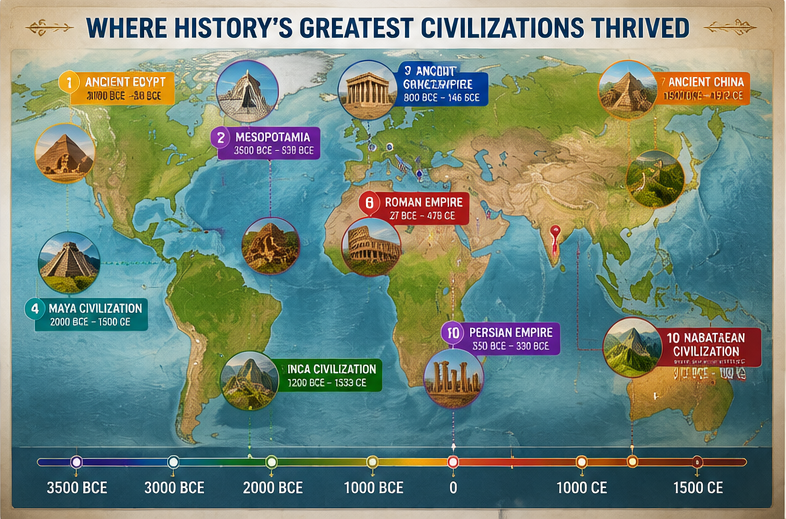
Answer: Mesopotamia is widely regarded as one of the earliest known civilizations, emerging around 3500 BCE.
2. Which ancient civilization had the best drainage system?
Answer: The Indus Valley Civilization is famous for its sophisticated urban drainage and sanitation systems.
3. Why are the Egyptian pyramids still standing?
Answer: The pyramids were built using durable limestone and granite, careful engineering, and stable foundations that have helped them survive for thousands of years.
4. Which civilization invented paper?
Answer: Ancient China is credited with the invention of paper, which revolutionized communication and record-keeping.
5. Did ancient civilizations understand astronomy?
Answer: Yes. Civilizations such as the Maya, Egyptians, and Babylonians closely observed the skies to create calendars and predict seasonal events.
6. What can we still learn from ancient civilizations?
Answer: Their approaches to city planning, water management, engineering, agriculture, and sustainable construction continue to influence modern society.
Conclusion
Ancient civilizations achieved extraordinary things with the knowledge and tools available to them. Their innovations in architecture, science, engineering, and governance laid the foundations for many aspects of modern life. Even today, researchers continue to uncover new discoveries that reveal just how advanced these societies truly were.
Suggested Stories
- 10 Mind-Blowing Space Facts Scientists Still Can’t Explain
- 5 Untold Stories That Quietly Changed History Forever
- 15 Amazing Human Body Facts That Sound Fake (But Are True)
External References
- UNESCO World Heritage Centre – https://whc.unesco.org/
- The British Museum – https://www.britishmuseum.org/
- Smithsonian Institution – https://www.si.edu/
- National Geographic – History – https://www.nationalgeographic.com/history/
- Encyclopaedia Britannica – https://www.britannica.com/