
10 Mind-Blowing Space Facts Scientists Still Can’t Explain
Have you ever looked up at the night sky and wondered how much we still don’t know about the universe?
Despite incredible discoveries, scientists admit that many mysteries remain unsolved. From invisible matter to strange planets, space continues to surprise us.
Here are ten amazing space facts that are real—and still leave experts searching for answers.
1. Most of the Universe Is Invisible
Scientists estimate that everything we can see—stars, planets, and galaxies—makes up only about 5% of the universe.
The remaining 95% is believed to be dark matter and dark energy, which cannot be directly observed.
2. Nobody Knows What’s Inside a Black Hole
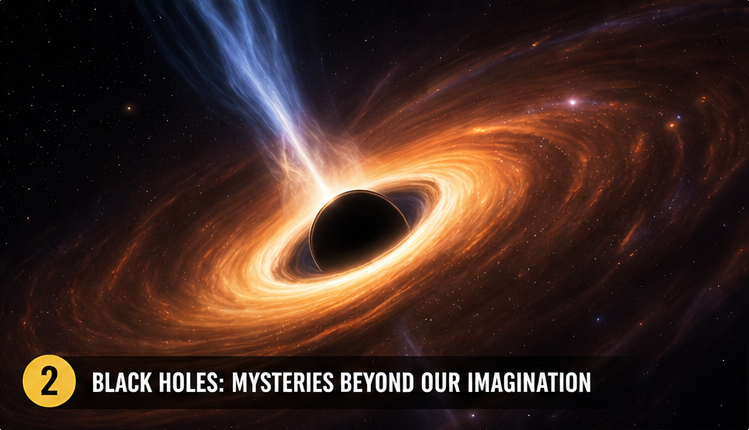
Black holes have gravity so strong that even light cannot escape.
What exists beyond the event horizon is still one of the greatest mysteries in science.
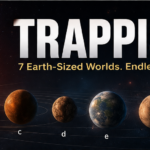
3. There May Be More Earth-Like Planets Than We Think
Astronomers have discovered thousands of exoplanets.
Many are located in the “habitable zone,” where liquid water could exist.
4. Time Moves Differently in Space
According to Einstein’s theory of relativity, time slows down near extremely strong gravity.
Astronauts actually age very slightly slower than people on Earth.
5. The Universe Keeps Expanding Faster
Scientists expected gravity to slow the universe’s expansion.
Instead, it is speeding up because of a mysterious force called dark energy.
6. Some Stars Are Bigger Than Our Entire Solar System
Stars like UY Scuti are so enormous that if placed where our Sun is, they would stretch beyond Jupiter’s orbit.
7. Space Is Surprisingly Quiet
Since sound requires air to travel, space is completely silent.
Explosions in movies would actually make no sound in space.
8. There Could Be Oceans Under Frozen Moons
Moons like Europa and Enceladus hide giant oceans beneath thick layers of ice.
Scientists believe these oceans could possibly support life.
9. The James Webb Space Telescope Keeps Finding New Surprises
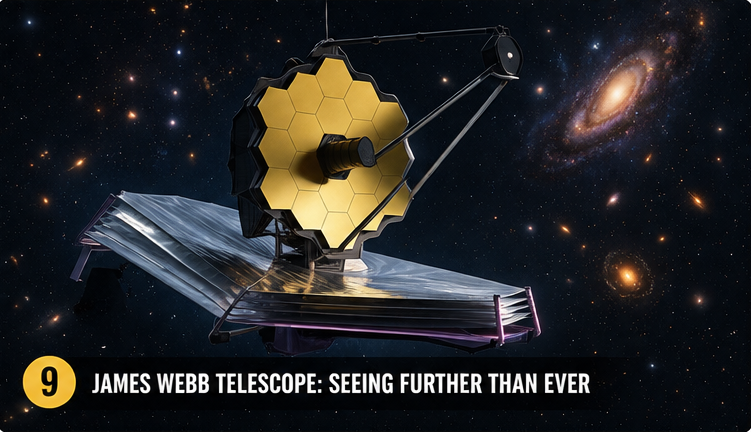
The telescope has discovered ancient galaxies that appear much older and brighter than scientists expected.
These discoveries continue to challenge existing theories.
10. We Still Don’t Know If We’re Alone
The Milky Way contains hundreds of billions of stars.
Yet despite decades of searching, we have found no confirmed evidence of intelligent alien life.
The search continues.
Final Thoughts
The universe is far more mysterious than we once believed.
Every year, scientists discover something that changes our understanding of space.
Who knows? The next great discovery could happen tomorrow.
Frequently Asked Questions
1. What is the biggest mystery in space?
Answer: Dark matter and dark energy remain the biggest unsolved mysteries.
2. Is there life outside Earth?
Answer: Scientists have not confirmed extraterrestrial life, but many planets could potentially support it.
3. Why is space silent?
Answer: Because there is almost no air in space for sound waves to travel through.
4. Can humans travel to another galaxy?
Answer: Not with current technology. The distances are far beyond our present capabilities.
5. Can the James Webb Space Telescope see the beginning of the universe?
Answer: The James Webb Space Telescope can observe some of the oldest galaxies ever discovered, helping scientists study the early universe. While it cannot see the exact moment of the Big Bang, it provides valuable clues about how the first stars and galaxies formed.
6. What is the coldest place in the universe?
Answer: The Boomerang Nebula is considered the coldest known natural place in the universe, with temperatures around −272°C (1 Kelvin). It is even colder than the natural background temperature of space.
Conclusion
Space reminds us how much there still is to learn. Every telescope, spacecraft, and mission brings us closer to understanding the universe, but many questions remain unanswered. That mystery is what makes space so fascinating.
Suggested Internal Links
- Wow! Signal Mystery – The 72-Second Message From Space
- TRAPPIST-1 Star System Explained
- S5 Possible Habitable Planets That Could Change Humanity’s Future


Pingback: 10 Ancient Civilizations That Were Far More Advanced Than You Think (2026 Guide)