7 Time Travel Ideas That Sound Like Science Fiction
Imagine stepping into a machine tonight and walking out 100 years in the future.
You look around. The cities are different. Technology has changed. Nobody remembers the world you came from.
Sounds like a science-fiction movie, right?
But here’s the strange part: time travel isn’t completely outside the laws of physics.
Scientists have already demonstrated that time can pass at different rates depending on speed and gravity. The real question is whether humans could ever control these effects enough to travel through time.
Here are 7 fascinating time travel ideas inspired by real science.
1. Time Dilation: The Closest Thing We Have to Time Travel
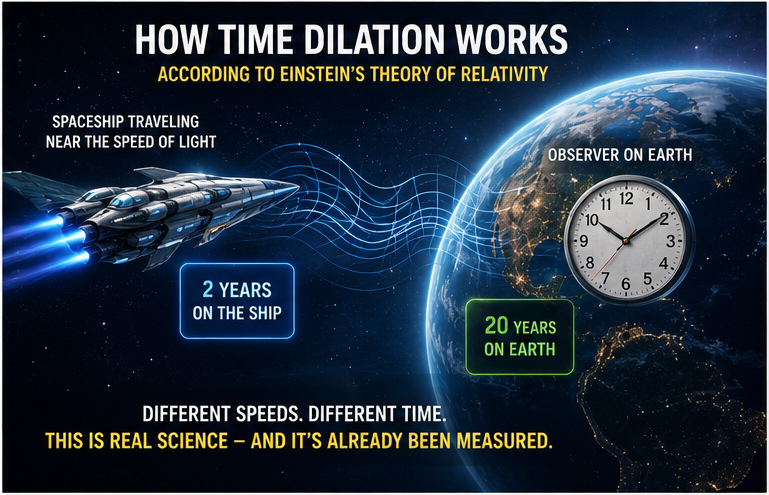
According to Einstein’s theory of relativity, time doesn’t pass at exactly the same rate for everyone.
If you travel extremely fast, close to the speed of light, time passes more slowly for you compared with someone who remains behind.
Imagine two identical twins.
One stays on Earth while the other travels through space at an enormous speed and eventually returns.
The traveling twin could have experienced less time than the twin who stayed on Earth.
This isn’t just science fiction. Time dilation has been measured using extremely precise clocks and is important for technologies such as GPS.
In a sense, traveling into the future is already allowed by physics.
2. Wormhole : A Shortcut Through Spacetime
What if the universe contains shortcuts?
A wormhole is a theoretical structure that could connect two distant regions of spacetime.
Instead of traveling billions of kilometers through ordinary space, you could theoretically enter one side and emerge somewhere else.
But there’s an even stranger possibility.
If the two ends of a wormhole experienced different amounts of time, scientists have explored whether such a structure could potentially create a path between different times.
The problem?
We have never observed a usable wormhole, and keeping one open may require forms of matter or energy that we don’t currently know how to produce or control.
3. Traveling Near a Black Hole
Black holes have some of the strongest gravitational fields in the universe.
According to relativity, stronger gravity can cause time to pass more slowly relative to an observer farther away.
So imagine a spacecraft traveling near—but safely outside—the region around a massive black hole.
The crew might experience much less time than people far away.
They wouldn’t necessarily be traveling backward through time.
Instead, they could return to find that much more time had passed elsewhere.
It sounds like a movie plot, but the underlying effect comes from Einstein’s theory of relativity.
4. Cosmic Strings: The Universe’s Hypothetical Time Machine?
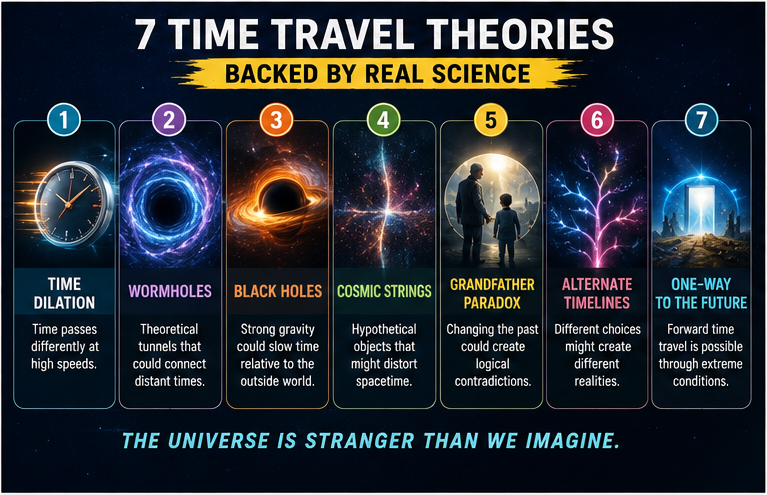
Cosmic strings are hypothetical, extremely thin structures that some theories suggest could have formed in the early universe.
They haven’t been confirmed to exist.
But physicists have explored whether certain configurations of cosmic strings could distort spacetime in unusual ways.
Some theoretical models have even suggested possibilities involving closed paths through spacetime.
If cosmic strings exist, they could potentially become one of the strangest objects in the universe.
For now, though, they’re firmly in the theoretical category.
5. The Grandfather Paradox
Now things get really weird.
Suppose you travel back in time and accidentally prevent your grandfather from meeting your grandmother.
Then you would never be born.
But if you were never born, who traveled back in time?
That’s the famous Grandfather Paradox.
It highlights one of the biggest problems with backward time travel: cause and effect could become contradictory.
Scientists and philosophers have proposed different ways around the paradox, including ideas involving alternate timelines or restrictions on what a time traveler could change.
But we don’t know whether backward time travel is physically possible.
6. Could the Universe Create Alternate Timelines?
Here’s where physics starts sounding like science fiction.
Some interpretations of quantum mechanics involve the idea that different possible outcomes may correspond to different branches of reality.
This has inspired the popular idea of alternate timelines.
A time traveler could theoretically travel into the past and create a different branch rather than changing their own original history.
That would avoid some classic time-travel paradoxes.
However, it’s important to remember that this is an interpretation and theoretical concept—not evidence that time machines or alternate universes can actually be accessed.
7. Maybe Time Travel Only Goes Forward
Here’s the most realistic twist.
You don’t necessarily need a machine that sends you into the future.
Physics already allows one-way travel into the future at different rates.
Travel extremely fast.
Spend time in a region with very different gravitational conditions.
Return to Earth.
You could theoretically discover that more time has passed for everyone else than for you.
The challenge is making the effect large enough to matter for a human traveler.
That would require extraordinary technology and energy.
So, Can We Actually Build a Time Machine?
For now, no working machine can send humans into the past or hundreds of years into the future on demand.
Forward time travel through relativistic time dilation is supported by established physics.
Backward time travel remains highly speculative and faces enormous theoretical problems.
That’s what makes the subject so fascinating.
The universe doesn’t simply treat time like a clock ticking at exactly the same speed everywhere.
Time is connected to space, motion, gravity, and the structure of spacetime itself.
And we are still discovering what that really means.
The Most Fascinating Question
Perhaps the biggest mystery isn’t:
“Can we build a time machine?”
It’s this:
“What would happen if we actually could?”
Would changing the past create a new timeline?
Would the universe prevent paradoxes?
Could you meet your future self?
Or is the past permanently locked away?
We don’t know.
And that’s exactly why time travel remains one of the most fascinating ideas in science fiction.
Frequently Asked Questions (FAQ’s)
1. Is time travel scientifically possible?
Answer: Forward time travel through time dilation is consistent with Einstein’s relativity and has been experimentally observed. Travel into the past remains hypothetical.
2. Can humans travel through time?
Answer: Humans naturally move forward through time. Relativistic effects can cause different observers to experience different amounts of elapsed time, but practical large-scale time travel isn’t currently possible.
3. Can a wormhole be used as a time machine?
Answer: Some theoretical physics models explore this possibility, but no usable wormhole has ever been observed or created.
4. Can we travel back in time?
Answer: There is currently no experimental evidence that humans can travel backward in time. Some mathematical solutions in relativity allow unusual spacetime structures, but their physical reality is uncertain.
5. What is time dilation?
Answer: Time dilation is an effect predicted by relativity in which different observers can measure different amounts of elapsed time depending on their relative motion or gravitational environment.
6. What is the grandfather paradox?
Answer: It is a thought experiment showing a logical contradiction that could occur if someone traveled into the past and changed an event that was necessary for their own existence.
7. Will we ever build a time machine?
Answer: Nobody knows. Current physics provides interesting possibilities for forward time travel, but there is no known practical technology capable of creating a science-fiction-style time machine.
Final Thought
For centuries, humans have looked at the passage of time as something unstoppable and absolute.
Modern physics gave us a much stranger picture.
Time can stretch.
Time can slow down.
And under extreme theoretical conditions, spacetime may behave in ways that are difficult to imagine.
Maybe humans will never travel through time.
Or maybe, somewhere in the distant future, someone will look back at our century and wonder why we thought it was impossible.
Until then, the clock keeps ticking.
Interesting Blog Posts
- 10 Mind-Blowing Space Facts Scientists Still Can’t Explain
- TRAPPIST-1 : The Tiny Star With Seven Earth-Like Worlds
- 10 Everyday Technologies You Use That Were Invented by Accident
- 10 Ancient Civilizations That Were Far More Advanced Than You Think
Recommended External References
- NASA – Is Time Travel Possible?
- NASA – Einstein’s Theory of Relativity and GPS
- Einstein Online – Time Dilation
- Einstein Online – Wormholes
- Physical Review Letters – Wormholes, Time Machines, and the Weak Energy Condition