
10 Everyday Technologies You Use That Were Invented by Accident
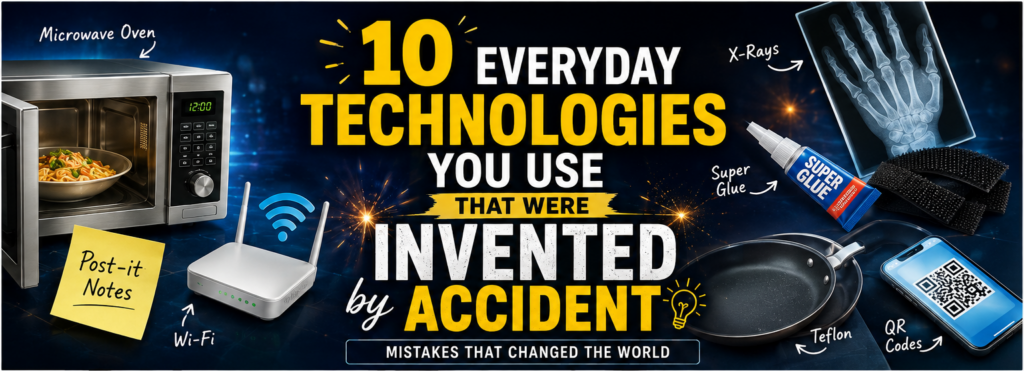
Many of the technologies we rely on today weren’t created according to a perfect plan. In fact, some of the world’s biggest breakthroughs happened because of unexpected mistakes, lucky accidents, or experiments that went in a completely different direction.
Here are 10 everyday technologies that changed our lives—all thanks to accidents.
1. The Microwave Oven
In 1945, engineer Percy Spencer noticed that a chocolate bar in his pocket melted while he was working with radar equipment. This unexpected discovery led to the invention of the microwave oven.
Today it’s used for:
- Heating food
- Cooking meals
- Defrosting frozen food
2. Wi-Fi
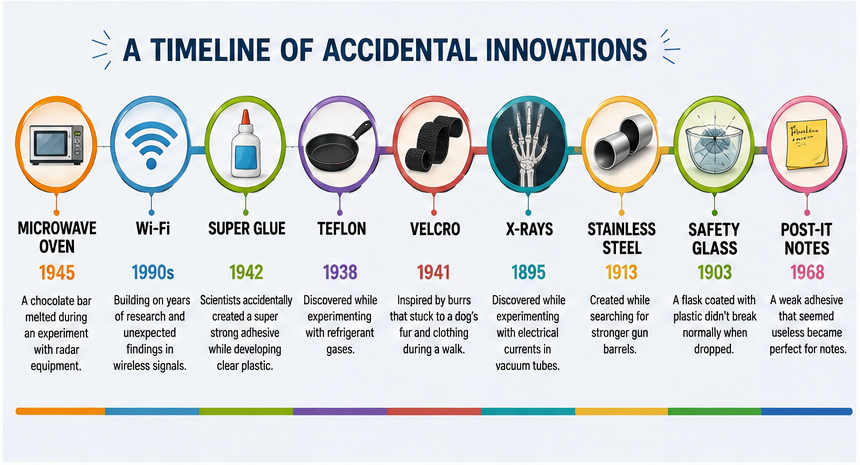
While Wi-Fi wasn’t discovered by accident, a key technology behind modern wireless communication was inspired by research into radio signals and unexpected findings in astronomy and signal processing. Years of experimentation led to the wireless networking we use every day.
3. Super Glue
Scientists were trying to develop clear plastic for military equipment when they accidentally created an extremely strong adhesive.
Today, Super Glue is used in homes, industries, and even some medical procedures.
4. Teflon
Chemist Roy Plunkett accidentally discovered Teflon while experimenting with refrigerant gases.
Today it’s found in:
- Non-stick cookware
- Industrial machinery
- Medical equipment
5. Velcro
Swiss engineer George de Mestral noticed tiny burrs sticking to his clothes and his dog’s fur after a walk. Examining them under a microscope inspired the hook-and-loop fastening system we know as Velcro.
6. X-Rays
Physicist Wilhelm Röntgen discovered X-rays while experimenting with electrical currents in vacuum tubes.
This accidental breakthrough transformed modern medicine.
7. Stainless Steel
While searching for stronger gun barrels, researchers accidentally created a metal that resisted rust and corrosion.
Today it’s used in:
- Kitchen appliances
- Buildings
- Medical instruments
8. Safety Glass
A scientist accidentally dropped a glass flask coated with plastic. Instead of shattering into dangerous pieces, it cracked while staying together—leading to laminated safety glass.
9. Post-it Notes
A weak adhesive developed during research seemed like a failure at first. Later, it became the perfect solution for removable notes used in offices and schools worldwide.
10. QR Codes
Originally developed to improve manufacturing and inventory tracking in the automotive industry, QR codes unexpectedly became a global technology for payments, tickets, menus, product information, and digital sharing.
Why Accidental Inventions Matter
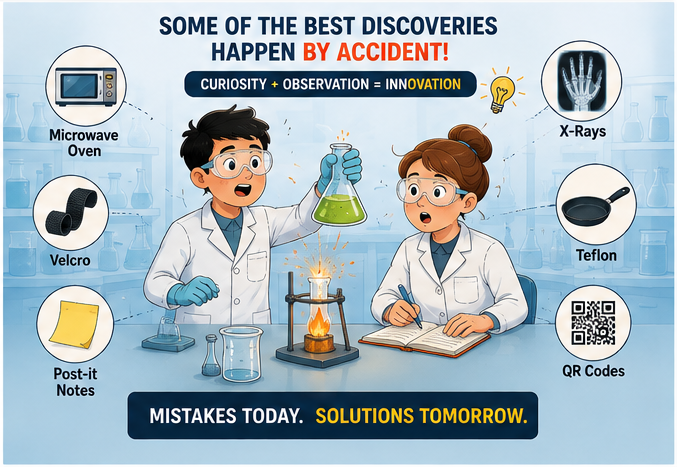
Innovation doesn’t always follow a straight path. Many discoveries happen because curious people notice something unusual and explore it further.
These accidental inventions remind us that mistakes can sometimes lead to the biggest breakthroughs.
Frequently Asked Questions
1. What is the most famous accidental invention?
Answer: The microwave oven is one of the best-known accidental inventions, discovered after a radar experiment unexpectedly melted a chocolate bar.
2. Was Wi-Fi invented by accident?
Answer: No. Wi-Fi was the result of decades of research, though several supporting discoveries came from unexpected observations and experiments.
3. Why are accidental discoveries important?
Answer: Unexpected discoveries often open new areas of science and technology that researchers were not originally trying to create.
4. Which accidental invention has had the biggest impact?
Answer: Many experts consider X-rays, stainless steel, and the microwave oven among the most influential accidental inventions because of their impact on medicine, industry, and daily life.
5. Are accidental inventions still happening today?
Answer: Yes. Modern breakthroughs continue to emerge from unexpected research findings, especially in materials science, medicine, and electronics.
6. What can inventors learn from accidents?
Answer: Curiosity, careful observation, and a willingness to explore unexpected results are often just as important as following a planned experiment.
Conclusion
Some of the greatest technologies in history weren’t planned—they were discovered by people who paid attention when something unexpected happened. These stories show that innovation often begins with curiosity and the courage to explore the unknown.
Interesting Blogs
- 10 Ancient Civilizations That Were Far More Advanced Than You Think
- 15 Everyday Myths You Still Believe (But Are False)
- 10 Everyday Psychology Tricks Your Brain Uses Without You Realizing
External References
- Smithsonian Institution – https://www.si.edu/
- IEEE – https://www.ieee.org/
- National Inventors Hall of Fame – https://www.invent.org/
- Britannica – https://www.britannica.com/
- NASA – https://www.nasa.gov/




Pingback: 10 New Technologies That Could Change Everyday Life Before 2030
Percy Spencer discovering the microwave after noticing a melted chocolate bar is a fascinating reminder that accidental observations can reshape everyday life. I’m curious to explore more creative experiments with Tripoai.
Percy Spencer discovering microwave technology after a chocolate bar melted in his pocket is a fascinating reminder that accidents can spark major innovations. It also makes me wonder what unexpected ideas could emerge from experimenting with this Digen AI tool.