
10 New Technologies That Could Change Everyday Life Before 2030
Technology doesn’t always arrive with a dramatic launch.
Sometimes it starts quietly in a laboratory, university, factory, or research center—and a few years later, it completely changes everyday life.
From batteries that could become part of a vehicle’s structure to new forms of wireless sensing and quantum security, several emerging technologies are moving from research toward real-world applications.
The World Economic Forum’s 2026 emerging-technology report highlights technologies selected for their novelty, development progress, and potential impact.
Here are 10 new technologies worth watching before 2030.
1. Structural Battery Technology
Imagine an electric car where some of the body itself helps store energy.
That’s the basic idea behind structural batteries.
Traditional batteries are heavy components installed inside a vehicle. Structural battery technology aims to combine energy storage with structural materials.
If the technology becomes practical at scale, vehicles could potentially become lighter while making better use of available space.
That could be especially interesting for:
- Electric vehicles
- Drones
- Aircraft
- Robotics
- Portable electronics
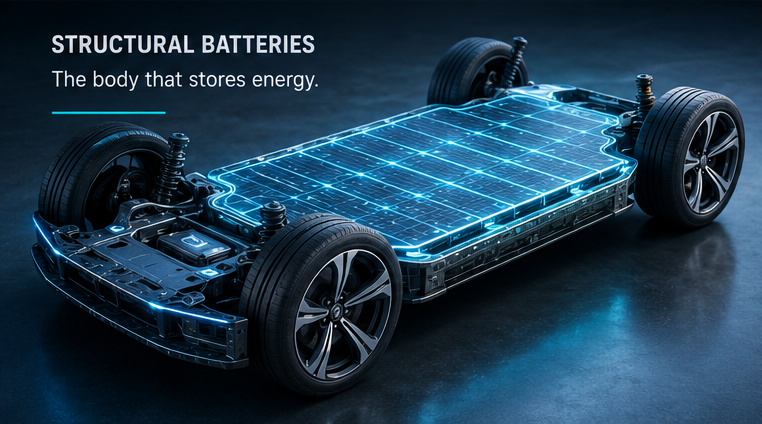
It’s a simple idea with a potentially huge impact: the structure of a machine could also become part of its battery.
2. Quantum Cryptography
As computers become more powerful, protecting sensitive information becomes increasingly important.
Quantum cryptography uses principles of quantum physics to create new approaches to secure communications.
One particularly interesting concept is quantum key distribution, where the properties of quantum particles can be used to detect attempts to intercept a communication.
The technology isn’t going to replace every password tomorrow.
But as quantum computing develops, quantum-resistant and quantum-based security technologies could become increasingly important.
3. Advanced Nuclear Energy
Nuclear energy is getting another wave of attention.
Researchers and companies are developing new reactor concepts designed to improve safety, efficiency, flexibility, and fuel usage.
Some emerging designs are smaller than traditional nuclear power plants and could potentially be deployed in different locations.
The goal isn’t simply to build bigger reactors.
It’s to explore new ways of producing reliable low-carbon electricity.
4. Batteries Made for More Than Cars
The battery revolution isn’t only about electric vehicles.
Better energy-storage systems could change how homes, buildings, and electricity grids operate.
Imagine storing excess electricity when demand is low and using it later when demand rises.
Large-scale storage could help renewable energy sources such as solar and wind become more useful because electricity could be stored and delivered when needed.
The result could be a more flexible electricity system.
5. Everything-to-Grid Technology

Here’s an interesting idea.
Your electric car could eventually become more than a vehicle.
It could also act as a temporary energy-storage device.
With vehicle-to-grid and broader “everything-to-grid” approaches, electric vehicles and home batteries can potentially send stored electricity back into a grid when required.
The World Economic Forum specifically highlights everything-to-grid technology as an emerging area in 2026.
Imagine coming home, plugging in your car, and having it help power your house later.
6. Advanced Sensors That Can Detect More
Sensors are becoming increasingly sophisticated.
Future sensing systems could detect environmental changes, chemical signals, biological activity, and other information with greater sensitivity.
This could affect:
- Healthcare
- Agriculture
- Environmental monitoring
- Industrial safety
- Smart cities
Instead of waiting for a problem to become obvious, highly sensitive sensors could help detect changes much earlier.
7. Engineered Living Systems
This sounds like science fiction, but researchers are exploring ways to use living cells and biological systems for useful purposes.
One emerging area involves engineered living therapeutics, where modified biological systems could potentially deliver treatments in highly targeted ways.
The technology is still developing and raises important safety and regulatory questions.
But it represents a fascinating shift:
Instead of making everything from machines, we may increasingly use biology itself as a technology.
8. New Materials That Are Stronger and Smarter
Materials science could quietly transform everyday products.
Researchers are developing materials with unusual combinations of strength, flexibility, conductivity, heat resistance, and other properties.
These materials could eventually be used in:
- Electronics
- Vehicles
- Buildings
- Batteries
- Medical devices
- Industrial equipment
The most important technology of the future may not always look futuristic.
Sometimes it could simply be a better material inside something you already use.
9. Tiny Technologies for Cleaning and Protecting the Environment
Scientists are exploring new materials and chemical systems that could help remove pollutants, improve water treatment, or make industrial processes more efficient.
One example is the development of advanced catalysts and nanozymes—materials designed to perform functions similar to biological enzymes.
If these technologies become inexpensive and scalable, they could have applications in environmental cleanup, water treatment, manufacturing, and healthcare.
10. Smart Technology That Disappears Into the Background
The next generation of technology may actually involve less visible technology.
Instead of constantly staring at screens, sensors and connected devices could quietly monitor environments and provide information when needed.
Think:
- Smart homes
- Connected vehicles
- Wearable devices
- Ambient sensors
- Intelligent infrastructure
The technology could become almost invisible.
And that might be one of the biggest changes of all.
What Will Technology Look Like in 2030?
We often imagine the future as flying cars, robots, and giant holograms.
But real technological change can be much quieter.
A better battery.
A smarter sensor.
A stronger material.
A safer communication system.
A more flexible electricity grid.
These small improvements can eventually have enormous effects.
And several of the technologies discussed here are already moving beyond the laboratory toward real-world deployment.
The Most Exciting Part?
We don’t know which technology will become the next smartphone-sized breakthrough.
Some ideas will succeed.
Some will remain expensive.
Others may disappear completely.
That’s normal.
Technology has always been a process of experimentation.
The technology that changes your life in 2030 might already exist today—but you probably haven’t heard of it yet.
Which one would you most like to see become reality?
Frequently Asked Questions (FAQ’s)
1. What are emerging technologies?
Answer: Emerging technologies are new or developing technologies that have the potential to create significant changes in society, business, science, or everyday life.
2. What technology will change the world by 2030?
Answer: There is no single answer. Energy storage, advanced materials, quantum security, sensing, biotechnology, and other emerging fields could all have major impacts.
3. Which future technology is closest to becoming mainstream?
Answer: Several emerging technologies are already entering commercial applications, although their availability and maturity vary significantly by industry and region.
4. Will batteries improve before 2030?
Answer: Battery technology continues to evolve, with research focusing on energy density, safety, cost, charging, materials, and applications beyond conventional electric vehicles.
5. Could electric cars power homes?
Answer: Technologies such as vehicle-to-home and vehicle-to-grid systems can allow compatible electric vehicles to supply electricity externally. Broader everything-to-grid systems are also being developed.
6. Is quantum cryptography already available?
Answer: Quantum communication and quantum key distribution technologies exist, but widespread consumer adoption is still limited.
7. Will future technology make life easier?
Answer: Some technologies may make tasks easier, safer, faster, or more efficient. However, emerging technologies can also introduce new challenges involving cost, privacy, security, regulation, and environmental impact.
Final Thought
The future probably won’t arrive all at once.
It will arrive piece by piece.
One new battery.
One breakthrough material.
One smarter sensor.
One new energy system.
And eventually, we’ll look around and realize that the future has quietly become everyday life.
Recommended External References
- World Economic Forum: Top 10 Emerging Technologies of 2026
- World Economic Forum: Everything-to-Grid Energy
- NIST: Post-Quantum Cryptography




The discussion of structural batteries, wireless sensing, and quantum security shows how research can quietly reshape everyday technology before the public notices. I’m curious to see whether this tool can help communicate these complex developments through more engaging visual stories.
Great post. The examples you gave made it click for me in a way the theory never did. I run my photos through enhance HDR photos online afterwards when I need a quick boost, so this came at a good time.