Why Airplane Windows Have a Tiny Hole? The Surprising Truth Behind It
Have you ever sat beside an airplane window, looked outside, and noticed a tiny little hole near the bottom of the window?

At first glance, it might look like a manufacturing mistake. After all, why would an aircraft have a hole in something that is supposed to keep passengers safe thousands of feet above the ground?
But here’s the interesting part: that tiny hole is intentional, and it has an important engineering purpose.
Known as a bleed hole or breather hole, this small feature helps manage pressure inside the aircraft window assembly. It is one of those clever details that most passengers overlook but aviation engineers carefully consider.
Let’s discover how it works and why it matters.
1. What Is the Tiny Hole in an Airplane Window?
The tiny hole you notice near the bottom of many airplane windows is called a bleed hole or breather hole.
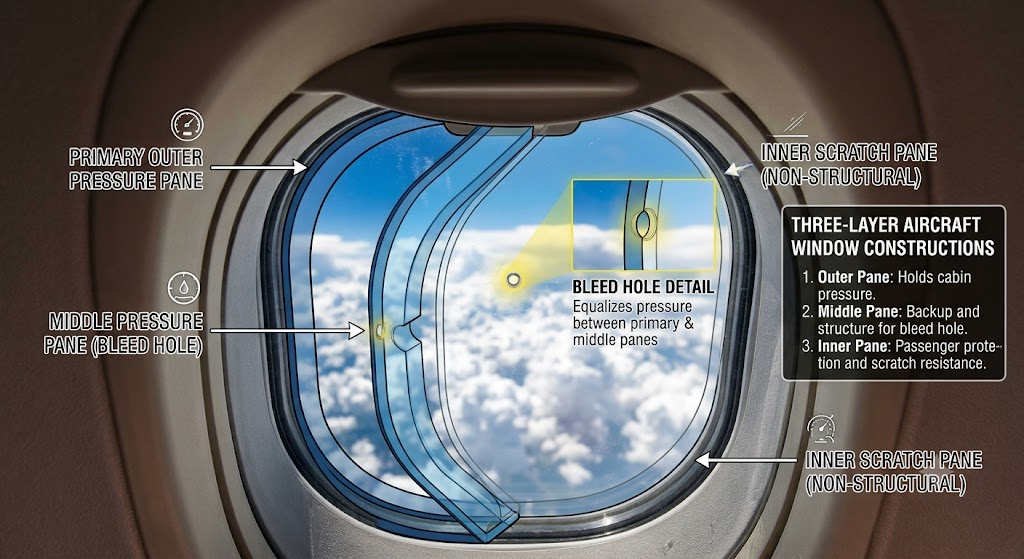
It is generally located in the middle pane of the passenger window assembly, not in the outermost structural pane.
Many commercial aircraft passenger windows use multiple layers:
- Outer pane: Faces the outside environment and is designed to withstand the main pressure difference.
- Middle pane: Provides an additional structural barrier and commonly contains the tiny breather hole.
- Inner pane: The protective panel passengers can touch from their seats.
These layers work together as part of the aircraft’s window design.
The hole is not an accidental crack or damage. It is a deliberately designed feature.
2. Why Do Airplane Windows Need a Tiny Hole?
The main reason is pressure management.
When an aircraft reaches cruising altitude, the air pressure outside becomes much lower than the pressure maintained inside the passenger cabin.
Aircraft cabins are pressurized to provide a suitable environment for passengers and crew.
This creates a pressure difference between the cabin and the outside atmosphere.
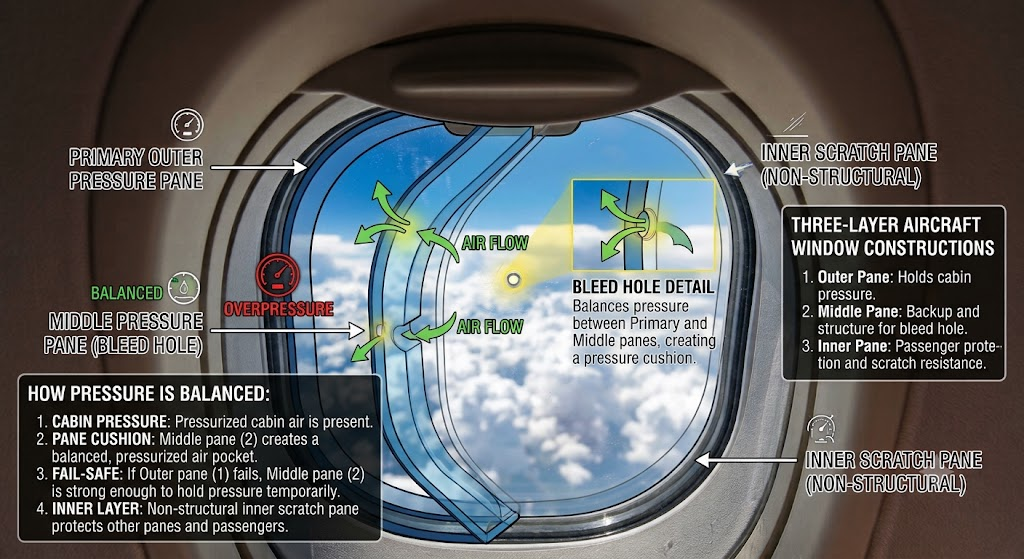
The tiny hole allows cabin air to enter the space between the middle and outer window panes. This helps balance pressure across the middle pane so that the outer structural pane carries the main pressure load.
Without this carefully designed arrangement, pressure could be distributed differently across the window layers.
The tiny opening therefore plays a useful role in the overall engineering of the window assembly.
3. How Does the Tiny Hole Actually Work?
Think of it as a small pressure-balancing passage.
As the airplane climbs, the pressure outside decreases. Meanwhile, the aircraft maintains a higher pressure inside the cabin.
The breather hole allows air to pass into the space between the window panes.
This helps equalize pressure in that space with cabin pressure, allowing the outer pane to bear the main pressure difference.
The middle pane also provides an additional layer of protection if the outer pane is damaged.
It is a simple-looking feature that supports a carefully engineered system.
4. Does the Hole Help Prevent Window Fogging?
Yes, it can also help manage moisture.
Temperature differences between the aircraft cabin and the outside atmosphere can create condensation around window surfaces.
The small passage allows air and moisture to move through the window assembly, helping reduce the possibility of moisture becoming trapped between panes.
That is another useful benefit of this tiny design feature.
5. What Happens If an Airplane Window Pane Gets Damaged?
Airplane windows are designed with multiple layers and safety considerations.
The structural panes are engineered to handle the pressure loads associated with normal flight conditions.
On many aircraft designs, the middle structural pane can provide additional protection if the outer pane fails.
This does not mean that every aircraft uses exactly the same window arrangement. Designs can differ between aircraft models and manufacturers.
The important point is that aircraft windows are engineered as assemblies, rather than relying on a single ordinary sheet of glass.
6. Why Are Airplane Windows Usually Rounded?
Here’s another interesting aviation design detail.
Have you noticed that passenger airplane windows are generally oval or rounded rather than square?
This is related to how stress is distributed around an opening in the aircraft fuselage.
Sharp corners can create stress concentrations, which are undesirable in a pressurized aircraft structure.
Rounded window designs help distribute structural stress more smoothly around the opening.
The importance of window shape became particularly clear during early jet aviation, when aircraft structural fatigue and pressurization issues led to important improvements in aircraft design.
It is another example of how small design decisions can have major engineering benefits.
7. Should You Be Worried If You See a Hole in Your Airplane Window?
Absolutely not, if you are looking at the normal, designed breather hole.
It is a standard feature on many passenger aircraft window assemblies.
However, a genuine crack, unexpected damage, or loose window component is different. If you notice anything unusual, inform a flight attendant rather than attempting to inspect or touch the window assembly.
You should also never attempt to block or modify the small opening.
8. The Next Time You Fly, Look for This Tiny Detail!
The next time you get a window seat, take a moment to look near the bottom of the window.
You might spot the tiny breather hole that you never noticed before.
It is a reminder that aircraft engineering involves thousands of carefully designed details, many of which passengers never think about.
From cabin pressurization to window construction, even the smallest components can serve an important purpose.
Sometimes, the most interesting engineering secrets are hiding in plain sight!
Frequently Asked Questions
1. What is the tiny hole in an airplane window called?
It is commonly called a bleed hole, breather hole, or vent hole.
2. Is the tiny hole in an airplane window a manufacturing defect?
No. On window designs that include it, the hole is an intentional engineering feature.
3. Does the hole make an airplane window safer?
It helps manage pressure between the window panes as part of the overall window design.
4. How many layers do airplane windows have?
Many passenger aircraft windows have three visible layers or panels, although the exact construction varies by aircraft.
5. Can air enter through the tiny airplane window hole?
Yes. It allows air to pass between the cabin and the space between window panes.
6. Do all airplanes have tiny holes in their windows?
No. Window designs vary between aircraft and manufacturers, and not every aircraft window uses the same arrangement.
7. Why are airplane windows rounded?
Rounded corners help reduce stress concentrations around openings in the aircraft structure.
Final Thoughts
It helps manage pressure between window panes and supports the design of an aircraft window system that must operate under demanding conditions.
A tiny hole in an airplane window might seem insignificant, but it is a fascinating example of practical engineering.
So, the next time you fly, look closely at your window. You might discover that one of the most interesting features of your journey was sitting right beside you all along.
Enjoyed this surprising fact? Share this article with someone who loves travelling, aviation, and discovering how everyday things work!
Discover more interesting facts, travel stories, and technology insights on TalePrime.com.