
15 Everyday Myths You Still Believe (But Are False)
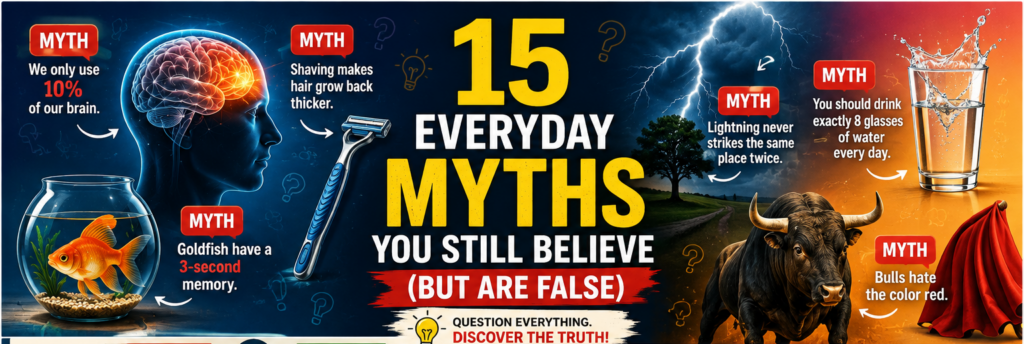
We’ve all heard advice from parents, teachers, or friends that seemed completely true. But over time, science has shown that many of these “facts” are actually myths.
Let’s separate fact from fiction with these 15 everyday myths.
1. We Only Use 10% of Our Brain
Myth: Humans use only 10% of their brain.
Fact: Brain scans show that almost every part of the brain has a function. Throughout the day, different regions become active depending on what you’re doing.
2. Cracking Your Knuckles Causes Arthritis
Myth: Knuckle cracking leads to arthritis.
Fact: Research has found no strong evidence that cracking your knuckles causes arthritis. It may annoy people around you, but it’s not known to damage healthy joints.
3. Goldfish Have a Three-Second Memory
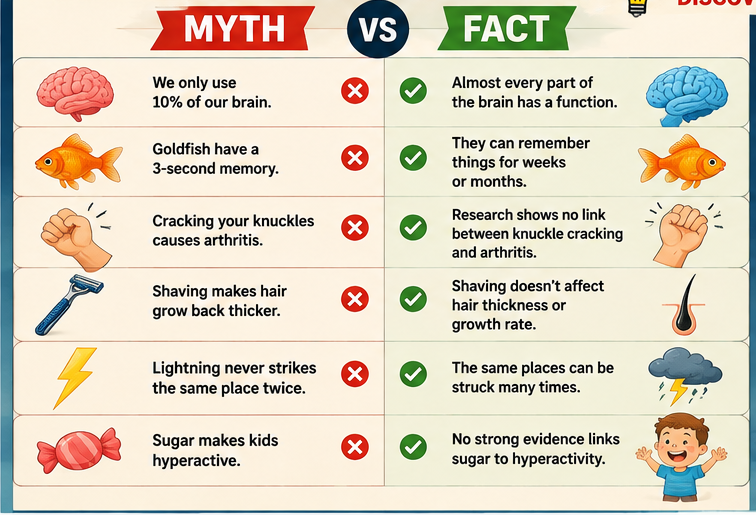
Myth: Goldfish forget everything after three seconds.
Fact: Goldfish can remember information for weeks or even months and can learn simple routines.
4. Shaving Makes Hair Grow Back Thicker
Myth: Hair becomes thicker after shaving.
Fact: Shaving cuts hair at the surface. The blunt tip can make new growth feel coarser, but it doesn’t change the hair’s thickness or growth rate.
5. Lightning Never Strikes the Same Place Twice
Myth: Once lightning strikes a place, it won’t happen again.
Fact: Tall buildings, towers, and trees are often struck many times during storms.
6. Sugar Makes Kids Hyperactive
Myth: Eating sugar always makes children hyper.
Fact: Most scientific studies have not found a consistent link between sugar and hyperactivity in children. Exciting situations like parties may be the real reason.
7. You Should Drink Exactly Eight Glasses of Water Every Day
Myth: Everyone needs exactly eight glasses daily.
Fact: Water needs vary depending on age, weather, activity level, and diet. Many people get water from foods and other beverages too.
8. Bats Are Blind
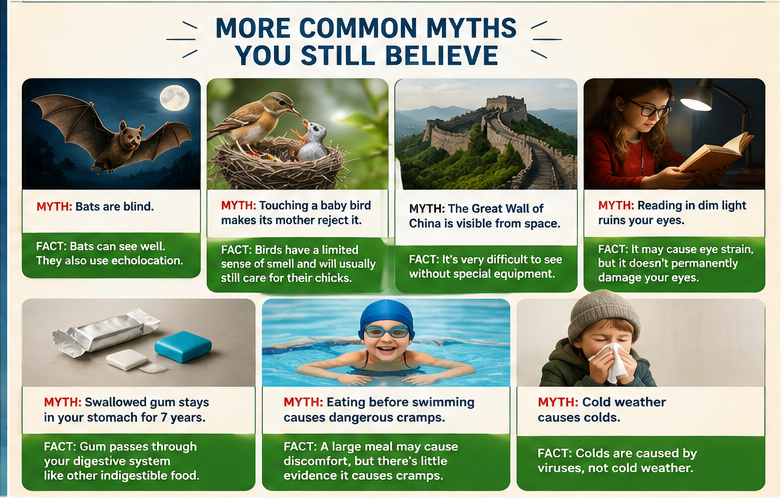
Myth: Bats can’t see.
Fact: Most bats have good eyesight and also use echolocation to navigate in the dark.
9. Touching a Baby Bird Makes Its Mother Reject It
Myth: Birds abandon chicks if humans touch them.
Fact: Most birds have a limited sense of smell and usually continue caring for their chicks.
10. The Great Wall of China Is Visible From Space
Myth: It’s easily visible from space with the naked eye.
Fact: Under normal conditions, astronauts say Great Wall of China is very difficult to see without assistance.
11. Cold Weather Causes Colds
Myth: Going outside in cold weather gives you a cold.
Fact: Colds are caused by viruses, not cold temperatures. However, viruses may spread more easily in certain conditions.
12. Swallowed Gum Stays in Your Stomach for Seven Years
Myth: Gum remains inside your body for years.
Fact: Your digestive system cannot digest gum well, but it usually passes through the body like other indigestible materials.
13. Reading in Dim Light Ruins Your Eyes
Myth: Dim light permanently damages vision.
Fact: It may cause temporary eye strain or discomfort, but it doesn’t permanently damage healthy eyes.
14. Bulls Hate the Color Red
Myth: Bulls become angry because they see red.
Fact: Bulls react to movement, not the color itself. They have limited color vision.
15. Eating Before Swimming Causes Cramps
Myth: You must wait 30 minutes after eating before swimming.
Fact: A large meal may make you feel uncomfortable, but there’s little evidence that a normal meal significantly increases the risk of dangerous cramps.
Why Do Myths Last So Long?
Many myths continue because they are repeated from generation to generation. Once an idea becomes familiar, people often accept it without checking the evidence.
Learning the facts helps us make better decisions and understand the world more accurately.
Frequently Asked Questions
1. Why do people believe common myths?
Answer: Many myths spread through family traditions, social media, movies, and repeated stories that sound believable.
2. Are all popular myths false?
Answer: No. Some popular beliefs are supported by evidence, while others have been disproved through scientific research.
3. How can I tell if a fact is true?
Answer: Check reliable sources such as scientific organizations, universities, government health agencies, or peer-reviewed research.
4. Why does misinformation spread so quickly?
Answer: People are more likely to share surprising or emotional information, even if it hasn’t been verified.
5. Can myths be harmful?
Answer: Some myths are harmless, but others can lead to poor health decisions, safety risks, or misunderstandings.
6. Where can I verify science and health facts?
Answer: Trusted organizations like the World Health Organization (WHO), the Centers for Disease Control and Prevention (CDC), and educational institutions provide reliable information.
Conclusion
Not everything we’ve heard growing up is true. Science continues to test old beliefs and replace myths with evidence. The next time you hear a surprising “fact,” take a moment to verify it—you might discover the truth is even more interesting.
Interesting Blogs
- 15 Amazing Human Body Facts That Sound Fake (But Are True)
- 10 Everyday Psychology Tricks Your Brain Uses Without You Realizing
- 5 Untold Stories That Quietly Changed History Forever
External References
- World Health Organization (WHO): https://www.who.int/
- Centers for Disease Control and Prevention (CDC): https://www.cdc.gov/
- National Institutes of Health (NIH): https://www.nih.gov/
- Britannica: https://www.britannica.com/




Pingback: 12 Places on Earth That Look Like Another Planet
I liked the thoughtful tone you maintained throughout. It made the article feel inviting and helped me stay engaged with the discussion.