
7 AI Scams You Need to Watch Out for in 2026

Artificial intelligence is making our lives easier. It can write emails, create images, translate languages and even talk like a real person.
But there is another side to AI.
Scammers are also using artificial intelligence to make their tricks more convincing.
From fake voices and deepfake videos to realistic messages and malicious apps, online scams are becoming harder to recognize. Recent reports in India have highlighted how cybercriminals are using social media, fake apps and other techniques to target users.
Here are 7 AI scams you should know about in 2026.
1. AI Voice Scams
Imagine receiving a phone call from someone who sounds exactly like your friend, family member or boss.
They say they have an emergency and urgently need money.
The voice may sound real because scammers can use AI to imitate someone’s voice from a relatively small amount of audio.
How to stay safe
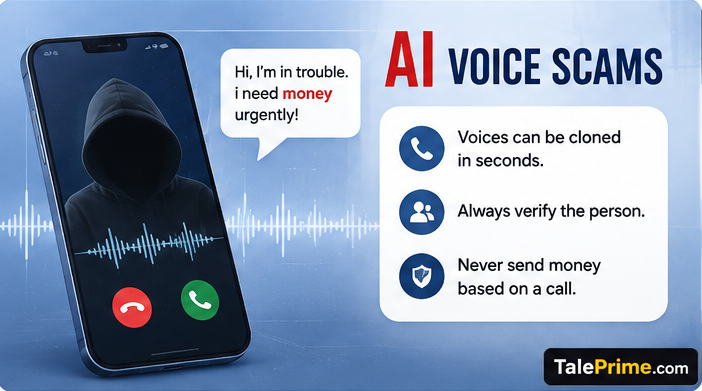
Don’t send money simply because someone sounds familiar.
Hang up and call the person back using a number you already trust.
2. Deepfake Video Scams
AI can now create surprisingly realistic videos.
Scammers can use manipulated videos of celebrities, business leaders or even people you know to promote fake investments, products or schemes.
A video looking real doesn’t necessarily mean it is real.
Watch for:
- Strange facial movements
- Unnatural blinking
- Poor lip synchronization
- Strange lighting
- Suspicious websites or payment requests
When money is involved, verify the information from another source.
3. Fake AI Investment Opportunities
“AI-powered investment.”
“Guaranteed AI returns.”
“Use our AI trading system and double your money.”
These types of claims can look attractive.
Scammers may create professional-looking websites, fake testimonials and even AI-generated videos to make an investment scheme appear legitimate.
The simple rule
If someone promises guaranteed high returns with little or no risk, be extremely careful.
Never invest simply because an advertisement looks professional.
4. AI-Powered Phishing Messages
Traditional scam messages were often easy to spot because of spelling mistakes and strange grammar.
AI can change that.
Scammers can now create convincing emails, SMS messages and social media messages that look professional.
The message might pretend to come from:
- Your bank
- A delivery company
- Your employer
- A government department
- A popular online service
Before clicking
Stop.
Check the sender.
Look at the website address.
And avoid clicking links in unexpected messages.
5. Fake Customer Support Scams
You search online for customer support and find a phone number.
You call.
Someone answers professionally and asks you to install an application or share an OTP.
Unfortunately, the person may not be genuine.
Scammers increasingly use fake websites, advertisements and social media profiles to impersonate legitimate companies.
Remember
A genuine support representative should not ask you to reveal your banking password, PIN or OTP.
6. AI-Generated Fake Profiles
Have you ever received a friend request from someone who looks completely real?
That profile could be fake.
AI can help scammers create realistic profile photographs, biographies and messages.
The scammer may spend days chatting with the victim before eventually asking for money or personal information.
Protect yourself
Don’t trust an online profile simply because the photograph looks real.
Check the account’s history, mutual connections and other information before trusting someone.
7. Fake Apps and Malicious Downloads
This is one of the most dangerous tricks.
A scammer may advertise an attractive app through social media. The app could promise entertainment, exclusive content, rewards or another tempting offer.
But installing it could expose your device or personal information.
Recent reporting in India found malicious Android applications being promoted through misleading social-media advertisements.
Stay safe
Download apps only from trusted sources.
Check the developer name.
Read reviews carefully.
Avoid installing applications sent through random links.
How to Protect Yourself From AI Scams

You don’t need to become a cybersecurity expert.
Just follow a few simple rules.
Think before you click
An urgent message is often designed to make you panic.
Slow down.
Verify unusual requests
If someone asks for money or sensitive information, verify them using another communication method.
Never share OTPs
Your OTP should remain private.
Don’t trust screenshots
Screenshots, videos and even voices can be manipulated.
Check website addresses
Look carefully before entering passwords or payment information.
Keep your phone updated
Install security and operating-system updates regularly.
Be careful with unknown apps
Avoid installing applications from random websites or messages.
The Biggest AI Scam Warning Sign
The biggest warning sign isn’t bad grammar.
It is pressure.
If someone says:
“Act now.”
“Don’t tell anyone.”
“Your account will be blocked.”
“Send the money immediately.”
Stop.
Take a breath.
Verify the request independently.
Scammers want you to make a decision before you have time to think.
Final Thoughts
AI itself isn’t the problem.
The problem is how criminals can use powerful technology to make old scams look more believable.
As AI becomes better at generating voices, images, videos and text, our ability to verify information becomes even more important.
The next time something online looks too convincing, don’t ask only:
“Does this look real?”
Ask:
“How can I verify that it is real?”
That one question could save you from becoming the next victim of an AI scam.
Stay curious. Stay careful. Think before you click.
FTC – What to Do if You Were Scammed
Also Check Interesting Blogs
- TRAPPIST-1 : The Tiny Star With Seven Earth-Like Worlds
- 15 Everyday Myths You Still Believe (But Are False)
- 10 New Technologies That Could Change Everyday Life Before 2030
- 7 Time Travel Ideas That Sound Like Science Fiction



The warning about fake voices, deepfake videos, and malicious apps is especially relevant as AI scams become more convincing. Resources like Freepikai can help readers explore AI tools while staying more alert to potential risks.
Great post. The examples you gave made it click for me in a way the theory never did. I run my photos through HDR photo enhancer free afterwards when I need a quick boost, so this came at a good time.
The warning about AI-generated fake voices and deepfake videos is especially important, since scammers can now sound remarkably convincing. Understanding legitimate voice tools like voicemaker.info also helps users recognize how easily synthetic audio can be created.